Chris will be signing and selling books at the Tatnuck Bookseller at 18 Lyman St. in Westborough, MA on Saturday, November 1st from 3:30 – 5:30 pm.
Please stop by if you’re in the area!

Chris will be signing and selling books at the Tatnuck Bookseller at 18 Lyman St. in Westborough, MA on Saturday, November 1st from 3:30 – 5:30 pm.
Please stop by if you’re in the area!
Chris will be signing and selling books at the Millbury Public Library on Saturday, September 27th from 10 am – 1 pm as part of the Local Author Expor Event hosted by the Friends of the Millbury Public Library.
The other authors attending are Joan Vincent, Sarah Blanchard, Wayne Berard, Annabelle Ritzer, Tony Gallo, Elizabeth Despres, Alison Hall, Elaina White, and E.D. Hackett.
Please come and check it out if you’re in the area!

Chris and MSI Press are happy to announce that they are collaborating with the U.S. Pain Foundation on a promotion to raise awareness and resources for the chronic pain community. The U.S. Pain Foundation is a 501(c)(3) organization that empowers, educates, connects, and advocates for people living with chronic conditions that cause pain. Chronic pain affects nearly 50 million Americans, is the leading cause of long-term disability, and costs approximately $635 billion EACH YEAR in medical treatments, disability payments, and lost productivity.
Chris has been struggling with hip/sciatic pain for over a decade and is a regular donor to the U.S. Pain Foundation. “There aren’t too many organizations out there that do what they do,” says Chris “Given that September is Chronic Pain Awareness Month, it seemed like a good time to try to raise funds together.”
Starting today, MSI Press will be offering a 25% discount on all copies of Chris’ memoir, Nothing So Broken through their webstore, using the code PAIN25. In addition, Chris will donate any royalties from books that are purchased with this code to the U.S. Pain Foundation.
Please click here if you would like to purchase a copy of Nothing So Broken and help someone in pain.
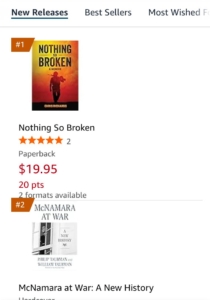
One week after its release, Nothing So Broken reached the #1 spot for Amazon’s New Releases among Vietnam War Biographies.
MSI Press LLC has announced that Chris’ memoir, Nothing So Broken, will be released for sale on August 29. The date has special meaning to the author, as it marks the birthday of his late father, Larry, who passed in April.
Pre-orders can now be placed online at Amazon, Target, and MSI Press. MSI Press is offering a 25% discount for orders through their website by using the code FF25 at checkout.
MSI Press LLC of Hollister, CA has agreed to terms with Chris to publish his memoir, titled Nothing So Broken.
MSI Press is a small, author-friendly publisher that was founded in 2003 by Betty Lou Leaver and her late husband, Carl Leaver to meet the foreign language education publishing needs of the now-defunct non-profit Coalition of Distinguished Language Centers. MSI Press was incorporated as a Limited Liability Corporation in 2012 and expanded to include a range of works of nonfiction beyond foreign language and culture. MSI Press LLC focuses on bringing the public unique books of recognized high quality, especially new authors with considerable talent.
“I’m excited to be partnering with Betty and the MSI Team,” says Chris. “They have an excellent track record working with first-time authors.”
A launch date for Nothing So Broken will be announced in the coming months.
Clear Path for Veterans – New England is hosting a 50/50 Raffle Fundraiser with the grand prize being drawn December 9th. Please consider donating to a worthy cause. They’ve been great with helping veterans in the area.
Easterseals MA released their 2022 Annual Report, showcasing the impressive impact of their programs and services. Also featured, were several inspiring stories from clients who have benefitted from their relationship.
Chris Richards was one of the clients.
Chris Richards was promoted to Director of Programming and Development for the Pocasset Pokanoket Land Trust. Prior to the move, Mr. Richards had served as a grant writer for the organization, working in a part-time role. In his new position, he will continue to lead all grant writing activities, while also being responsible for the success of the sustainable agriculture and food sovereignty programs. He will report directly to Chief Sequan Pijaki, Chairman of the Pocasset Wampanoag Tribe of the Pokanoket Nation.
March is Brain Injury Awareness Month, which seems timely as brain injuries have been the topic of too many recent conversations, posts, and text messages among my social circles. Two friends in their early fifties suffered strokes over the winter and my mother was in a car accident last summer, resulting in a concussion, followed by a stroke, followed by another stroke, followed by a mini-stroke.
Learning about each incident felt like a sledgehammer to the solar plexus. Then a week, month, six months of holding my breath, wondering about the recovery. Because there’s nothing quite like a brain injury with its distressing myriad of symptoms. The patient can survive, but their memories and perceptions may not, their connections may not. In some cases, the injury can result in a complete loss without a physical death.
The CDC estimates that over three million brain injuries happen every year in the United States. Of those, most are caused by trauma (TBI), such as falls, motor vehicle accidents, sports injuries, and assaults. But other types—strokes, tumors, and disease—are prevalent too, especially in the elderly. This has left an estimated five million Americans with some type of brain injury related disability and I suspect these numbers will increase as the Baby Boomers enter the later stages of life.
Although there’s no cure for brain injury (yet), we’re getting better as a society in improving the patient’s quality of life. The Brain Injury Association of America (BIAA) has played a major role in this. Founded in 1994 by a small group of the mothers of TBI patients, BIAA has grown into the nation’s largest brain injury advocacy and support nonprofit. The organization’s mission is to advance awareness, research, treatment, and education and to improve the quality of life for all people affected by brain injury. Services include organizing support groups, educating families and caregivers, and advocating federal and state governments for clinical funding.
So if you know one of the five million Americans struggling with a brain injury, please consider checking out the BIA chapter in your area (https://www.biausa.org/find-bia). Read a little bit on their website. See the different ways they’re supporting your community. Maybe even attend a conference or fundraiser. But make sure your friend or family member knows that help is out there.